Named after the stream of the same name that runs through it, the Lys valley is a place that exudes history: it was in fact colonised in the Middle Ages by the Walser population, who left deep traces here in the language, architecture and cultural traditions.
Also known as the Gressoney valley, the Lys valley is a jewel still little visited by mass tourism, where ancient traditions and surprising hospitality can be experienced.
In this guide you will find a few hints on what to see and do in the Lys valley, including enchanted villages, panoramic hikes and curiosities that (perhaps) you did not know!

Where is the Lys Valley?
The Lys Valley is located in the easternmost part of Aosta Valley, and is easily reached by car from both Piedmont and Lombardy, thanks to its proximity to the Pont-Saint-Martin motorway exit.
From Genoa to Pont-Saint-Martin it takes just over 2 hours.
Lys Valley what to see
The Lys Valley stretches from Pont-Saint-Martin to the foot of Mount Rosa, passing through the municipalities of Perloz, Lillianes, Fontainemore, Issime, Gaby and ending with Gressoney-Saint-Jean and Gressoney-La-Trinité.
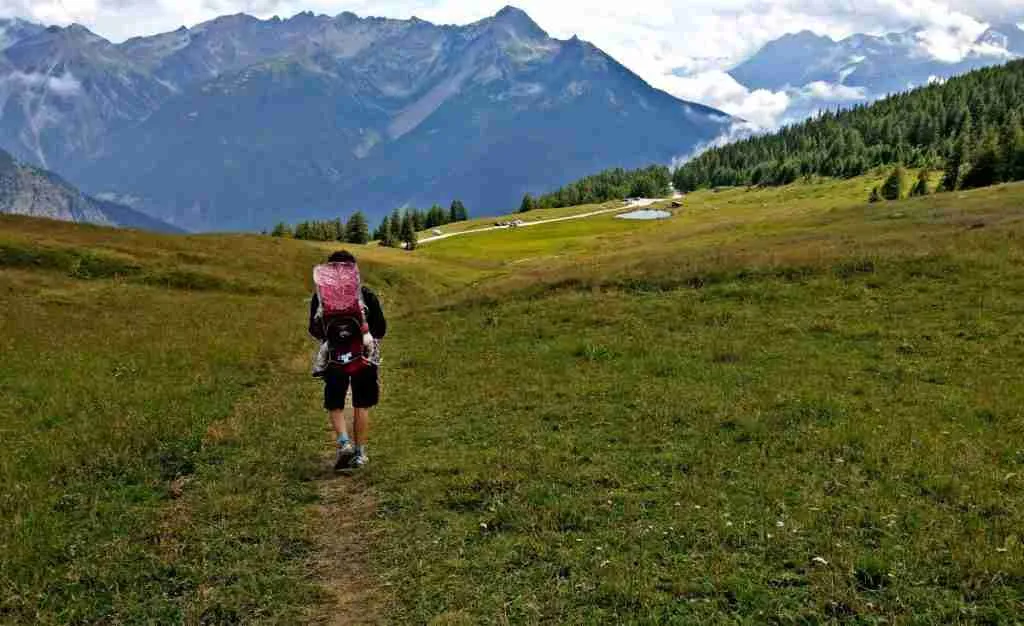
Along the route, we pass through very different environments: from terraced vineyards to chestnut groves, from coniferous forests to alpine meadows, and on to the majestic glaciers of Mount Rosa.

Pont-Saint-Martin
Pont-Saint-Martin is a village that was once one of the most active industrial centres in the Aosta Valley. Today, it is most famous for its imposing Roman bridge, the symbol of the village, which spans the Lys torrent.

It is an elegant single-arch bridge, suspended some 20 metres above the course of the torrent. The arch, built with five independent rows of ashlars, has withstood the frequent and violent flooding of the Lys for over two thousand years, thanks to the ingenious Roman construction technique.
Worth seeing in Pont-Saint-Martin are the ruins of the medieval castle, which belonged to the family of the same name, and the well-preserved stronghold in the centre of the village, known locally as ‘l’Castell’.
The stronghold can be visited at weekends in July and August without prior booking (opening hours 14:30-17:30, admission free). For information: municipal library tel. +39 0125.807793.
Just outside the village, in a slightly elevated position, is the Fontaney church, built by the Vallaise family. The building is a faithful, scaled-down reproduction of the Aosta cathedral, and is worth a visit for its architectural elegance and the landscape in which it is set.
Perloz and the village of Chemp
Perloz is one of the most historically relevant villages in the Lys valley.
Once considered the most important commune in the valley, it was the seat of the powerful Vallaise family and the first church in the valley, famous for the fresco of the Last Judgement decorating its façade.
The territory of Perloz is rugged, characterised by steep terraced slopes supported by dry stone walls, evidence of the peasant tenacity of yesteryear. Numerous scattered villages are nestled among the chestnut forests, at various altitudes, often in spectacular positions.

Prominent among them is the village of Chemp, a true hidden gem. Reachable on foot or via a narrow carriage road that climbs through the mountains, Chemp is located on a grassy promontory suspended between rock walls shaped by glaciers.
In recent years, Chemp has been transformed into an open-air museum thanks to the initiative of the artist Angelo Bettoni and other sculptors, who have scattered the village with works in wood and stone that are perfectly integrated into the rural context. Go to the complete article on Chemp.
Lillianes
Lillianes is a commune extending along the slopes of the lower Lys Valley, characterised by a main town located near the stream and a constellation of mountain villages scattered along the valley sides.

Some of these nuclei, such as the picturesque village of Varfei, which can be reached on foot or by car, retains its authenticity. Still visible are its granaries, built of wood and stone, used to store cereals and foodstuffs.
The Lillianes area is dominated by the massive presence of centuries-old chestnut groves, some of which date back more than 300 years.
Until the last century, the chestnut tree was considered the ‘bread tree’, as it represented the basis of food for many mountain families. The trees were grafted and cared for with great care, and the cultivated varieties served different purposes: fresh consumption, drying, smoking or processing into flour.
After harvesting, the chestnuts were threshed, sorted and dried in metati (small stone dryers), then smoked or ground to obtain a nutritious flour with which to make polenta, soups and a type of sweet, calorific bread, essential during the winter months.
Today, this ancient supply chain has been partly recovered thanks to the activities of the ‘Il Riccio’ Cooperative of Lillianes, which brings together local chestnut growers to collect, process and market chestnuts and their derivatives.
Every year, at the end of October, Lillianes celebrates the chestnut with one of the oldest festivals in the Aosta Valley, keeping alive a thousand-year-old agricultural tradition.
During the Chestnut Festival, the village comes alive with tastings and traditional music, and the Chestnut Museum also opens its doors to visitors. More information on the Chestnut Festival of Lillianes here.
Gressoney Valley: Fontainemore

The village of Fontainemore lies along the Lys stream, at a point where a narrow cleft between two rocks has allowed the construction of a characteristic bridge connecting the parish church to the village centre.
Worth seeing inside the church of Fontainemore, dedicated to San Antonio Abate, is the statue of the Black Madonna, which has a symbolic link with the Marian sanctuary of Oropa, also known for its Black Madonna.
The procession that every five years takes the faithful from Fontainemore to the Sanctuary of Oropa along the mule track that crosses the Colle della Balma located within the Mont Mars Nature Reserve (a protected area that preserves special environments, including numerous lakes and high-altitude wetlands) is historic.
What else to do in Fontainemore? Definitely take the ‘Fox Path”, a circular route designed to let you discover the most important sights in the village, along mule tracks and paths immersed in beech and chestnut trees, where cute wooden sculptures are hidden.

A children’s booklet-game also accompanies the walk, proposing a series of riddles for the children to answer, keeping them highly involved and – why not – stimulating even the laziest to walk. Go to the full article.
Issime and Gaby
Going up the Lys valley again, you come to Issime and Gaby where you can breathe in the true Walser culture, still alive in the architecture and customs. Here you can still admire the old houses (Stadel) from the 16th century, built in wood and stone.
Issime is the most representative centre of the Walser culture in which Titsch, the ancient Germanic dialect, is still spoken. Worth a visit in Issime is the parish church of San Giacomo, with its sumptuous Baroque wooden altar, and the Walser Documentation Centre, which recounts the daily life, customs and roots of this unique community.
Just above is the village of Gaby with its church of St John the Baptist, whose Romanesque bell tower stands out among the dark roofs of the huts. As you stroll through the scattered villages, you will see ancient rascards and grange, rural buildings suspended on stone pillars, built to protect crops from the humidity.
A short distance from Issime is the San Grato valley, which offers other splendid examples of Walser architecture.
But who are the Walser?

The Walser are a population of Germanic origin who, between the 13th and 14th centuries, migrated from the high valleys of the Swiss Valais to various areas of the Alps, including the Lys Valley. What pushed them towards new Alpine valleys was the need to find new pastures, land to cultivate and more stable living conditions.
Among the most characteristic elements of their culture are the traditional ‘mushroom’ houses, built of wood on sturdy stone pillars that raise the structure off the ground to protect it from moisture and rodents.
Even today, the Walser are recognisable by their language (such as titsch), traditional costumes and a culture deeply rooted in the mountains and community solidarity.
In Issime, titsch is still taught in schools!
Gressoney-Saint-Jean: the fairytale village

Gressoney-Saint-Jean is the fairytale village of the Lys Valley.
Strolling through the historic centre, among stone and wooden houses with flower-decked balconies, one can admire the typical Walser architecture and discover small corners rich in history.
Just above the village stands the fairy-tale Savoy Castle, the summer residence of Queen Margaret of Savoy, which can be reached from the centre along the so-called ‘Queen’s Walk’.

A stone’s throw from the centre, there is also Lake Gover, the ideal place for a family picnic with a view of Mount Rosa.
Finally, for trekking enthusiasts, we recommend Alpenzu Grande, an ancient high-altitude Walser village, which can be reached on foot along a slightly steep but short path. Go to the complete article on Gressoney-Saint-Jean.
What to see in the Lys Valley: Gressoney-La-Trinité
Gressoney-La-Trinité, the last village in the Lys valley, is nestled in a picturesque setting at the foot of Mount Rosa.
In summer you can explore beautiful high-altitude trails, while in winter the Monterosa Ski area, one of the largest in Europe, offers kilometres of spectacular slopes linked to Champoluc and Alagna.
Gressoney-La-Trinité also offers a dive into local culture with the Walser Museum, which recounts the life and traditions of this ancient Alpine people. Find the opening days here.
Finally, don’t miss the walk to the Alpenzu Piccolo, from where you can easily reach the other Walser village Alpenzu Grande via a 3-kilometre-long halfway path.
The path, marked W, starts near the village of Lysbalma in Gressoney-La-Trinité.
What to eat in the Lys Valley
The cuisine of the Lys Valley bears the legacy of the Walser culture, whose dishes tell of a simple but ingenious mountain life.
One can enjoy hearty soups, prepared with rye bread, cabbage and cheese, just as they were once cooked in communal village ovens. There is no shortage of mountain pasture cheeses and cured meats such as lard and mocetta, designed to keep for a long time, a fundamental quality in an often hostile environment.
To complete the meal, there are then simple but always nutritious desserts, made with local ingredients such as rye flour, chestnuts or walnuts.
Where to stay

Whether it is a refuge in an old walser house or a hotel with modern comforts, sleeping in the Lys valley is always an immersive experience in nature and regenerating. You can find the solution that best suits your needs on the booking portal Booking – compare offers here.
When to go to the Gressoney valley?
Every season in the Gressoney valley offers a different experience: from the fragrant spring blossoms, to summer hikes, to the evocative colours of autumn, to winter sports in the vast Monterosa Ski area. And once you’ve visited, you’ll find that every excuse is good to return!
This concludes our guide to the Lys valley, hoping to have offered useful hints to those approaching this fascinating corner of the mountains for the first time.
▶ Do you need travel insurance? As our reader, you are entitled to a 5% discount.